

NEWS
The Battlefield of Truth & Lies
“Ink-stained fingers trace the lines,
A battlefield of words, not mines,
Where truth is spun, a twisted thread,
By voices paid, by stories fed.”
"Cameras capture smoke and flame,
A hero's face, a nation's claim,
The fallen, glorified in frame,
While silent screams go unnamed."
"Headlines scream, a biased cry,
The enemy demonized, the 'other' lie,
A narrative crafted, meant to sway,
As hearts and minds are led astray. "
"The journalist, a soldier too,
With words as weapons, what to do?
To fight the tide, to risk it all, to seek the truth,
Or dance with power, and own a narrative
That doesn't necessarily even have to be the truth."

2020 BAI Board of Directors
The Board of Directors and Trustees are proud to announce our elected president and vice-president for the 2020 period.
This change is part of a bi-annual process where members are nominated for positions and elected by our Board of Directors/Trustees.
The Board of Directors and Trustees are proud to announce our elected president and vice-president for the 2020 period.
This change is part of a bi-annual process where members are nominated for positions and elected by our Board of Directors/Trustees.
Former president Zlatka Velagić served through an incredibly difficult time and helped navigate how we continue our work through the pandemic. She will continue on the Board of Directors as the secretary and is greatly involved in many of our project.
President - Adam Mirza
Adam has been a champion for BAI since the inception of BAI. Throughout the years, he’s championed voter-registration reform, developed key marketing strategies for BAI (such as Around the Džezva), and helped define BAI policy among a number of other initiatives as Chief Marketing Officer.
Adam was elected President and will continue BAI’s mission to preserve the culture and history of a sovereign Bosnia-Herzegovina.
Vice President - Amer Ramović
Amer will be assuming the role of Vice President. Amer has been a policy thought leader and has showcased continuous passion to the improvement of Bosnian-Herzegovinians throughout America and beyond. His participation in BAI has been critical to our success and we are excited to continue to see this progress as he transitions to this role.
The BAI team is excited to see what lies ahead as we continue to work hard. We thank our supporters for years of great work and hope to continue it going forward.

#BlackLivesMatter
The Bosnian American Institute (BAI) condemns the horrific killings of George Floyd, Ahmaud Arbery, Breonna Taylor, Manuel Ellis, and countless others. These horrendous events remind us of the systemic racism that continues to oppress Black communities all across America and beyond.
“The Bosnian American Institute (BAI) condemns the horrific killings of George Floyd, Ahmaud Arbery, Breonna Taylor, Manuel Ellis, and countless others. These horrendous events remind us of the systemic racism that continues to oppress Black communities all across America and beyond.”
We stand in solidarity with Black communities and the Black Lives Matter Movement. We recognize our duty, as neighbors to these communities and as citizens, to help our compatriots make their voices heard. Our experiences of injustice and intolerance have taught us that racism holds no bounds and that our fights must not be selective, but rather collective.
Our Bosnian-American community must recognize the privilege that our white community members have. It is not enough to not be racist - we must also participate in anti-racism, where we hold ourselves accountable to speak up against wrongdoings and atrocities. And we mean it when we say speak up; even if it means having uncomfortable, albeit necessary, conversations with our own families and friends.
We ask that our neighbors, supporters, and citizens support the movements that are fighting for justice at the forefront of these issues. Organizations like BlackLivesMatter and the American Civil Liberties Union (ACLU) work hard to provide opportunities for Black Americans in working against systematic oppression.
One of the core pillars of the Bosnian American Institute is education, and we strongly believe that we must all educate ourselves on systemic racism. Below, we have compiled resources for our community to learn more about the history and the multi-generational impact of racism on the Black and African-American community. We strongly encourage you to read about these organizations and donate or give support in any capacity.
Finally, the greatest power that an American citizen has is the ability to vote. We encourage our community to ensure they are registered voters. Research and support candidates who you believe will benefit society and fight against the systemic oppression we see. Make your voices heard through voting in local and national elections. We have provided a link to schedules that show upcoming primaries and election schedules below.
“Injustice anywhere is a threat to justice everywhere.” - Rev. Dr. Martin Luther King Jr.
#BlackLivesMatter
Sincerely,
The Bosnian American Institute
Organizational Resources
national (US)
Local (Washington State)
Material to educate
To Watch
13th (Netflix)
When They See Us (Netflix)
Just Mercy (Amazon Prime)
The Skin We’re In (CBC)
Explained: The Racial Wealth Gap (Netflix, S1E20)
To Read
So You Want to Talk About Race by Ijeoma Oluo
Between the World and Me by Ta-nehisi Coates
Blood In My Eye by George L. Jackson
The Fire Next Time by James Baldwin
How To Be An Antiracist by Ibram X. Kendi
Cover photo by Duncan Shaffer via Unsplash.

The Rundown: BiH Diasporic Conference 2019
BAI’s Vice President Dalila Zelkanovič visits BiH Diasporic conference and talks about what she learned about Bosnian-Herzegovinian Diaspora initiatives and the people are at the helm of those ships.
Representatives at BAI always seek to foster and sustain networks with like-minded individuals and organizations that work to preserve the culture and history of a sovereign Bosnia-Herzegovina. One such organizational effort is The BiH Diasporic Conference (BiHDC), which is the first of its kind that works to bring together a young generation of diaspora – a generation who, for the most part, has spent the majority of their lives living in the US and Canada. The conference's objective is to forge strong relationships and facilitate an inclusive environment for discourse.
Speakers Denis Hodžič and Amer Salihovič talk about strategies to organize the Diaspora community.
BiHDC boasts a grand vision of solidarity and education. Through their conferences, they spur conversations among the Diaspora about prejudice, history, societal norms, and many more expanding topics that pertain to Bosnia as a whole. Their hope is to lay a foundation for democratic discourse about Bosnia-Herzegovina (paraphrased from BiHDC’s mission statement).
Each year, the conference is hosted in a different city. Last year's took place here in Seattle. This year, Atlanta, Georgia hosted the fifth annual conference themed around "Bridging the Gap: Changemakers in Action." To upkeep our Bosnian tradition of returning visits to our guests, I kept my promise to those I networked with from Atlanta at last year's conference and attended this year's summit on behalf of BAI.
The conference's momentum centered around a common discussion we have at BAI, which is acknowledging that although we have a lot of educated individuals in the Bosnian diaspora, but also questioning the value of those degrees to our greater community. How do we leverage all of our degrees and all of our intellect to make it actionable for our one common denominator- Bosnia? It's easy to feel detached from our Bosnian heritage in our day to day; most of us work our 8-5 jobs, maybe binge on our Netflix series or drop by our gym, eat, sleep, and repeat. But then what? Involvement in organizations like BAI and BiHDC serve as a forum for meaningful engagement and discussion around the common goals and shortcomings many of us experience as Bosnian-Americans.
Senahid Halilovič’s book titled “Pravopis bosanskoga jezika,” meaning “Spelling of the Bosnian Language.”
The conference was packed with speakers that included Jasminko Halilovič who presented his work with the War Childhood Museum, Srđan Šarenac who presented his documentary "Two Schools" that showcased school segregation in Travnik, Emina Pelja who shared her entrepreneurial journey in building a brand that promotes diversity, Lucas Jensen who presented his documentary "Re:generacija" which follows youth from the three main ethnic groups in Bosnia as they engage with each other, community activists from Kentucky to New York, Maida Salkanovič who shared her research on the hidden consequences of trans-generational trauma, Ivona Boroje who discussed arts and culture in BiH and the diaspora, and closed with Senahid Halilovič who shared his research on linguistics as it pertains to the Bosnian language.
Just as stimulating were the discussions that occurred in the Q&As that followed each speaker. We exchanged ideas and community efforts, and even discussed how to respond to negative feedback such as "ovo što vi radite je bez veze." Hearing about all of these combined efforts reminds us all how immensely powerful it is to have knowledge of one's own heritage and culture. Culture functions ultimately to ensure the preservation and continuity of a people. By engaging in community involvement and organizations, we are preserving our rich culture and sustaining our sense of identity as Bosnian-Americans.
For more info on the BiH Diasporic Conference, visit them at http://bihdiaspora.com

Stav Magazine Interview with Irfan Mirza
Stav Magazine recently posted an article on their website of an interview with the Chair of Education of BAI, Irfan Mirza. Read the translated article here!
Stav Magazine recently posted an interview conducted by Enisa ALAGIĆ with the Chair of Education of BAI, Irfan Mirza.
Click here to read the original article.
Irfan Mirza's Interview
1. Možete li nam nešto više reći o sebi? Ko je Irfan Mirza? Čim se bavi?
Can you tell us something about yourself? Who is Irfan Mirza? What is your occupation?
I don’t think there is anything extraordinary about me. I work as a director at a technology company, where I run policy and regulatory compliance in the research division. I volunteer as the chair of education at the Bosnian American Institute, where I teach young people how to be strong and effective advocates for Bosnia and Herzegovina and their communities. I am married to a Bosnian and Herzegovinian, and we have 3 children, who are Bosnian and Indian, which is where I am originally from.
2. Odakle Vaše interesovanje za Bosnu i Hercegovinu i kakva je Vaša veza s BiH?
Where did your interest in Bosnia and Herzegovina come from, and what is your connection to BiH?
I was in Bosnia-Herzegovina from 1992 to 1994 delivering humanitarian aid and I worked with refugees in Dalmatia. During my time there, I learned a lot about the people, their character, habits, strengths and weaknesses. I got to see domestic and international politics in full view, as a horrific genocide was unfolding in front of my eyes. I saw the reaction of the Bosnians and how their social fabric, unity, and structure were being torn apart by forces that were manipulating them from outside the country.
3. Koliko znamo, Vaša supruga je porijeklom iz Bosne i Hercegovine. Kako ste se upoznali i kada? Čim se bavi vaša supruga?
As far as we know, your spouse is originally from Bosnia and Herzegovina. How did you meet and when? What is your spouse’s occupation?
My wife is from Donji Vakuf, which also classifies me as a Vakufljanin (odakle žena?). During the war, she took refuge in Dalmatia, where I met her. I was doing work in the refugee camps and she was trying to start a school in the camp. The Croatian authorities didn’t allow children from some of the camps to go to school. Therefore, I offered to help by teaching English. In return, I asked for her help with the Croatian government bureaucracy to get humanitarian supplies out of Croatia and into Bosnia and Herzegovina. We worked so well together, and she was such a strong advocate for Bosnia-Herzegovina, that I quickly developed an admiration for her. Today, she is a highly accomplished computer engineer, who now helps and advocates for Bosnian and Herzegovinian students trying to get into the field. She also helped me immeasurably with the book, in addition to taking care of my family obligations while I completed my research.
4. Kakav je Vaš angažman bio za vrijeme rata u BiH i kako ste doživjeli rat na terenu?
What was your engagement during the time of the war in BiH and how did you survive the war in theater?
I came to Bosnia-Herzegovina just after the start of the war to deliver humanitarian aid. My first trip was to Sarajevo. To get there, I had to drive through hostile checkpoints and front lines in Croatia and Bosnia-Herzegovina. When I got to Sarajevo, the residents warned me about snipers and I saw mortar shells destroying everything when they hit. I was shocked that such a thing could be happening in Europe in 1992. I saw an army that was sworn to protect its citizens, the JNA, turn its weapons against its own people, the people of Bosnia and Herzegovina. This was a clear betrayal. I saw militant extremists (Bosnian Serb forces) take up arms against their friends and neighbors so they could carve out an entity that could be annexed by Serbia. I saw copycat betrayal from the HVO, who tried to spin off an entity that could be annexed by Croatia. I spent two years crisscrossing front lines, navigating hostile checkpoints, coordinating aid efforts of NGOs, delivering aid that others couldn’t, and I saw the war nearly every day that I was there. I took pictures and documented what I experienced. I took what I had learned out of the war to raise awareness and to ask governments for help.
5. Izučavate bh. historiju i držite predavanja na tu temu. Šta vam je posebnon interesntno iz historije BiH?
You have learned Bosnia and Herzegovina’s history and hold lectures on the theme. What specifically interested you in the history of BiH?
Most Bosnians and Herzegovinians have been taught an ideologically biased interpretation of their own history. The interpretation is far from factual and misleading. The interpretation leads to Bosnians and Herzegovinians being second class citizens in their own land. It is an interpretation that is fraught with deception, about Bosnians and Herzegovinians being descendants of Slavs, getting their language from the Slavs, acquiring their culture from those of early Slav societies. It is an interpretation that makes Bosnians and Herzegovinians subservient to Slavs. Believe it or not, for the last two decades, I accepted that interpretation, or at least the small part of it that I knew.
For more than the last two decades, I have immersed myself in the culture, background, and social aspects of the Bosnian and Herzegovinian people. When my youngest son was about 5 years old, he asked me about the people of Bosnia and Herzegovina, where they came from, who they were, and what they were like? To answer his questions properly, I got a few books and dissertations and began reading them. I came across a genetic study from 2004 that found Bosnians had genetic markers that placed their ancestors back to the last ice age. I read about humans from the Paleolithic era living in Bosnia and Herzegovina. These genetic markers persisted through the Mesolithic and Neolithic eras, and they are continuing even today. These scientific discoveries directly conflict with the traditional texts that I read. That spawned four years of research to understand and explain the historical inconsistencies.
I began a series of lectures, so I could engage Bosnians and Herzegovinians on the topic and get their feedback on my findings. Many Bosnians and Herzegovinians didn’t like what I had to say. It was upsetting to them. My findings overturned some fundamental beliefs they had about themselves. Bosnians and Herzegovinians belong to different genetic groups than their neighboring Slavs. While you speak a Slavonic language, you are mostly not Slavs. You are natives of Europe. Slavs came to the region thousands of years later from other parts of Europe. This fact alone forces us to rethink the history of Bosnia and Herzegovina. It also made me rethink how I was going to present my thesis. I had to write a narrative that told the entire history of the people of Bosnia and Herzegovina from the beginning of humans in Europe. That is the only way to explain what I found. That narrative is my book, The History of Bosnia & Herzegovina.

The History of Bosnia & Herzegovina, written by Irfan Mirza. Published by Halton Creek Publishing.
6. Napisali ste i dvije knjige o Bosni i Hercegovini i genecidu. Šta je Vaša motivacija za pisanje knjiga o BiH?
You wrote two books on Bosnia and Herzegovina and genocide. What is your motivation for writing books on BiH?
I have completed two distinct pieces of work on Bosnia and Herzegovina, and a third is underway. At the beginning of the war in 1992, I did some research and published a short book that explained some basic facts about Bosnia and Herzegovina and its people’s desire to become independent of a crumbling and exploitative Yugoslavia. I wrote about the breakdown of Yugoslavia, and about Slobodan Milošević and his tyranny. People in the US and Canada didn’t really know anything about the war. Most of them never even heard the name Bosnia-Herzegovina. My second book is The History of Bosnia & Herzegovina. A few years ago, I began developing a framework to explain the Bosnian genocide. That work turned into a book entitled “A Framework to Understand the Bosnian Genocide.” However, that book has been put on hold until I completed the history book.
7. Koliko je trenutno Amerika uključena u procese u BiH?
How much is America currently included (dedicated) to processes in BiH?
From my perspective, America’s involvement in Bosnia and Herzegovina has been a roller coaster (up and down). Starting with support of the arms embargo that skewed the military outcome in favor of Serbia, America was a reluctant participant in Bosnia and Herzegovina’s well-being. But your readers already know that. They also know America’s role through NATO in the final offensives of the war, and in architecting the Dayton Accords. I think it is time to refresh the US position and bring new perspective into the insufficient discourse that is taking place on Bosnia and Herzegovina. I recently met with former President Haris Silajdžić, who described how the international community sees the conflict as a result of “ancient hatreds” which is a terrible mischaracterization. They explain it as “ethnic conflict” implying that it cannot be resolved. These unhealthy attitudes persist in the US among policy makers and influencers. Somebody has poisoned the well of knowledge, and to correct this, your diaspora is going to have to engage. They must learn how policy works and influence it. They will need the skill to challenge the State Department and the various “think tanks” that are overflowing with ill-informed opinions and inadequate analyses about the region. At the same time, your diaspora cannot afford to turn a blind eye to what is going on in Bosnia and Herzegovina. They need to address the discrimination and segregation that has the potential to destroy the fragile nation. So, it is up to the diaspora to grow quickly and fulfill this obligation that they have to their country of origin.
8. Posjećujte li Bosnu. Koliko se promijenila od rata do danas?
Do you visit Bosnia? How much has it changed from the days of the war?
I have not visited Bosnia and Herzegovina as much as I would like. There is a Bosnian sevdah song called “Razbolje se sultan” where the Sultan is dying, and when his son asks him about his regrets, the Sultan says he doesn’t regret leaving his wealth or position. But he says his regret is that he is leaving Bosnia. I feel that way about not visiting Bosnia and Herzegovina as frequently as I would like. I was there in the summer attending Professor Francis Fukuyama’s Leadership Academy Development Workshop, which was sponsored by Stanford and the University of Sarajevo. I finally got a formal lesson on Bosnia and Herzegovina’s politics, but I was also able to deliver a lesson on the history of Bosnia and Herzegovina. Some of the academics were surprised to hear someone from America telling them their own history. I hope to have a Bosnian language translation of the book this summer. I think it will be good for the people of Bosnia and Herzegovina to read it, and to learn that the Serbian language is actually a variant dialect of Bosnian Slavonic. In the book, I chose two separate tracks to explain my findings on this very controversial topic.
On this last trip, I noticed a lot of change from the time of the war, of course. The shipping containers placed around Sarajevo’s major intersections to stop sniper’s from targeting civilians were gone. You could finally look past Ali Pašina džamija to the other side of the Miljacka. I was impressed by the fast-paced young people of Sarajevo. I was fascinated by the young entrepreneurs in Mostar, and the enthusiasm of the young people in Konjic. I was thrilled to see the Paleolithic engravings at Badanj Pećina in Herzegovina. I was ecstatic to visit the Zemaljski muzej in Sarajevo, and thankful for the repairs they are making. I was pleased to see the necropolis at Radimlja so well cared for. I became enamored with Visoko and its ancient sites, Mili-Arnautovići, Okolište, Donji Meštro, and so on.
However, I was lost for prose to describe Potočari. My heart broke when I saw the memorial to the genocide. I wrote a poem about it and posted it online. People back home cried when they read it.
My final impression about Bosnia and Herzegovina since the war is that there is a growing anxiety among the population, on all sides. Veterans are protesting in tents in front of the Federation Prime Minister’s office. People all over the country cannot make ends meet, meaning the money they earn is not enough for the basics of life. There are little to no prospects for the future. People are fed up with party-based politics, rather than an issue-focused or strategic political agenda. Some Orthodox in Republika Srpska told me they are fed-up with “Srbvstvo” and “Srbovizacija.” It doesn’t buy them bread or help send their children to school. Some Catholics in Herzegovina say similar things about “Hrvatizacija.” I get the feeling that people are starting to realize that “Serb” and “Hrvat” identities have been forced upon them unnaturally. Bosnia and Herzegovina’s history shows these are external constructs that have been imposed artificially on some vulnerable people within Bosnia and Herzegovina. Those people were easily manipulated and thrust themselves into a frenzy to become complicit in terrible crimes, such as genocide, rape, torture, and mass murders. Today, they are manipulated into glorifying convicted war criminals and celebrating instead of mourning the atrocities they or their family members committed.
I was happy to see so many educated people return to Bosnia and Herzegovina from abroad. But many of them are becoming disillusioned; their expectations are not being met. At the same time, I became concerned when I talked to so many young people who want to leave. They feel there aren’t many prospects for them in terms of professional development or even the fulfillment of basic economic needs. Yet I remain optimistic about the future of Bosnia and Herzegovina. The reason I am optimistic is that a large number of Bosnians and Herzegovinians have resettled in nations with very strong academic programs that teach a different type of thinking than in Bosnia and Herzegovina. These escapees of the war and victims of ethnic cleansing are your diaspora. They are learning from new and different experiences. When these experiences and ideas are brought back to Bosnia and Herzegovina and paired with the values and experience of those who didn’t leave, I believe there will be a difference that will catapult the nation into prosperity and stability. There are generations of new leaders that are forming abroad. The war may have taken them out of Bosnia and Herzegovina, but nothing can take Bosnia and Herzegovina out of them. Their genetic encoding will bring them back home. History shows that happened 16,000 years ago. I am confident it will happen again.
9. Naučili ste i bosanski jezik. Je li bilo teško? Imate li neke zanimljive situacije da nam ispričate vezane za bosanski jezik?
You learned the Bosnian language. Was it difficult? Do you have any interesting situations to share with us about (learning) the Bosnian language?
I wouldn’t dare to say that I “learned” the Bosnian language. That would be a disservice to the people who teach it. I just happened to pick up a street vernacular. One of my friends from Sarajevo calls it “Čaršijska dialekt,” something you pick up in čaršija. I heard Bosnians and Herzegovinians speaking, and over time, I tried to mimic them. By trial and error, mostly error, I picked up enough to start speaking. My vocabulary grew when I started researching the history. I had to read countless texts, articles, and publications in Bosnian. The bibliography to the second edition has more than 300 references.
However, my grammar is non-existent, which is why I cannot write. I don’t know how to fully conjugate, nor do I know your padeži. While I understand most conversation and many forms of humor, I still have difficulty with sarcasm and poetry. I first picked up the language from my wife and a lady who was in the camp with her.
In 1993, I delivered some humanitarian supplies to an aid warehouse in Bugojno, and the people running it asked if I would give an interview to the local radio station. I agreed and went on the air, live. The journalist asked me to speak in Bosnian, so I answered her questions using the only Bosnian language skills that I had acquired by listening to my wife and the ladies in the refugee camp. I started saying things like they would say, “Ja sam prošla kroz Vrbanje.” “Saznala sam u Splitu da je Bugojno pod blokada…” Turns out, the entire town heard the broadcast—I had a captive audience, they were under blockade—and they laughed their heads off, especially the children. The next day, the children were impersonating me. After the interview, they finally told me that the Bosnian language is not gender neutral like English. At the end, the journalist thanked me for bringing both the food supplies and laughter back to her town. I was honored that I was able to deliver both in the middle of a horrible war.
10. Šta želite poručiti ljudima koji žele da opstane ideja Bosne, kao zemlje i mjesta različitosti i suživota?
What would you like to tell people who would like to see the idea of Bosnia, as a nation, a place of diversity and coexistence?
Bosnia and Herzegovina has been a refuge for humanity for more than 24,000 years. From the first humans to walk into Europe through Bosnia and Herzegovina before the last ice age, to European natives who took refuge there after the last ice age, Bosnia and Herzegovina is a place that has given protection to its population from both natural and manmade catastrophes. In 800 BC, when the Ilyr migrated to the region, they settled in Bosnia and Herzegovina. When the Slavs escaped slavery in the 5th century, they found refuge in Bosnia and Herzegovina—that’s how they got there by the way. When the Avar attacked the tribes around Bosnia and Herzegovina in the 6th century, those tribes found safety in Bosnia and Herzegovina. In the 7th century, the Khoro-athos marched through Bosnia and Herzegovina to settle in modern-day Croatia—that’s how the Croats got to their homeland. In the 9th century, when the king of Posavina, Ljudevit, had to make peace with the Slavs, he held the meeting in Bosnia and Herzegovina. When he was betrayed by the Slavs and had to escape his own kingdom, he escaped to Bosnia and Herzegovina. In the 10th century when the Dalmatians and Slavs felt threatened by the Bulgars, King Tomislav took his army to Bosnia and Herzegovina to fight Csar Simeon in the battle known as “bitka na bosanskim visoravnima.” When Cyril and Methodius went looking for a way to express the Christian liturgy in the local language, their students learned of a Glagolitic script known as Bosančica. When the Old Slavonic Church needed to expand its reach, it adopted the Bosnian dialect, so it could appeal to the masses. When the Jews were expelled from Spain in the 14th century, they found safety in Bosnia and Herzegovina. When the Croats and Serbs needed to make peace after the Second World War, Bosnia and Herzegovina was there for them. The story of the Sarajevo Haggadah from that time tells you clearly what Bosnians and Herzegovinians believe in.
Bosnia and Herzegovina is a land where its native kings protected religious freedom, such as Kralj Tvrtko I. Their belief in the diversity of the nation was so great that they resisted powers such as Rome and the Crusades that tried to homogenize them. In war after war against the people of Bosnia and Herzegovina, we saw Bosnians and Herzegovinians defend with the same pattern of bravery, chivalry, respect for humanity, and the protection of the weak. In the last war, Serbian forces tried to strip away all those principles that Bosnians and Herzegovinians have upheld for centuries. But even the fourth most powerful army in Europe couldn’t break the Bosnian and Herzegovinian spirit. The country did not capitulate, and it has not given in to the wave of ultra-fascist nationalism that is again threatening it.
Bosnia and Herzegovina has been, and will always be, a multi-confessional nation, where religious differences are respected. The country celebrates 2 Bajrams, 2 Christmases, 2 Easters, Jewish holidays, and so much more. It is a sanctuary for believers of all faiths. The current wave of fascism that was thrust upon Bosnia and Herzegovina from outside its borders is only a passing anomaly. It is a short blip (breakdown) in the long and rich history of the nation’s people. At some point in time, all the residents of Bosnia and Herzegovina will realize that you are all Bošnjak, regardless of whether you are Muslim, Catholic, Orthodox, Jew, Roma, Buddhist, Atheist, Agnostic, or any other confession.
Your future is promising, even with the dysfunctional structure that Dayton created in your nation. The differences that are defined by Dayton are artificial, and as such, they have an artificial lifespan. Bosnia and Herzegovina’s lifespan dates back to the earliest days of natives in Europe, and it will continue. In the foreword to the second edition of my book, Dr. Silajdžić writes that Bosnia-Herzegovina is an “authentically plural society, that, even damaged, still reflects what a united Europe aspires to be.” And that is the future of Bosnia and Herzegovina, an authentically plural society. I am privileged to be a student of the lessons that can be learned from this society.

2017 BAI Presidential Election
The Board of Directors and Board of Trustees are proud to announce our new president-elect Zlatka Velagić.
The Board of Directors and Board of Trustees are proud to announce our new president-elect Zlatka Velagić.
This change comes with the departure of our former president Mirza Velagić to continue his studies in Baltimore. Mr. Velagić served as the BAI president since our inauguration and Voices of the Bosnian Genocide’s (VOBG) president since 2011. He has shown great dedication and resolve for the organization and is proudly passing the torch to the ever-impactful Ms. Velagić.
Ms. Velagić has also served BAI since its inauguration and VOBG from its founding in 2011. She has taken leadership roles as Secretary of the Board of Directors and most recently as a member of the Board of Trustees. She is the current Fellow for the pillar of Education Innovation and has given many talks to communities across the United States.
The BAI team is excited about the future and our new leader. We welcome Ms. Velagić into her new role, and the Boards have shown their full support for her leadership. We encourage you to help us welcome our new President, Zlatka Velagić.

Syracuse Youth Hoist Bosnian Flag
The Bosnian Youth of Syracuse (BYS) organized a Bosnian-Herzegovinian Community Flag Raising Ceremony in collaboration with the City of Syracuse.
The Bosnian Youth of Syracuse (BYS) organized a Bosnian-Herzegovinian Community Flag Raising Ceremony in collaboration with the City of Syracuse. The event was created with the goal of “raising awareness of our community and its achievements” says Esmir Omerović, representative of BYS and it’s parent organization Islamic Cultural Center of Bosniaks in Syracuse (ICCBS).
This event comes days before the impactful Srebrenica Commemoration Day (July 11th) where we remember all those who lost their lives in the Srebrenica and Bosnian Genocide. However, the message of this event brought a different message.
Omerović quoted that one of their key themes this year was to “create stronger bonds within our communities.”
City of Syracuse Chief of Staff Bill Ryan attended the event. Leaders of the BYS, such as Emina Ramić and Anel Hirkić, addressed the audience with heartfelt closing remarks. New York State Senator David Valesky sent representatives to attend the event as well.
Over 50 people attended this momentous occasion of raising the Bosnian flag and we at the Bosnian American Institute could not be more proud of the efforts of the youth and community in Syracuse. Actions like theirs take a step forward in creating a more unified nation. With everyone’s help, we can continue to preserve the Bosnian-Herzegovinian heritage.
Today, July 9th, BYS also hosted a 5K walk in remembrance of those who lost their lives in the genocide. Be sure to give a like and follow to the BYS page to follow up on their efforts in Syracuse and to see any updates on the 5K walk.

Visit to Northern California
We are pleased to announce that the BAI education team will be at two additional events in Northern California. Our lectures provide a platform for the next generation of Bosnian Americans to be the best ambassadors of their Bosnian origins, identity, culture and history.
We are pleased to announce that the BAI education team will be at two additional events in Northern California. Our lectures provide a platform for the next generation of Bosnian Americans to be the best ambassadors of their Bosnian origins, identity, culture and history.
Our team for this trip is composed of:
Irfan Mirza, our senior lecturer whose passion for Bosnia has been demonstrated since the ‘90s.
Admira Sejfic, BAI’s trustee who has delivered multiple speeches on her experience as a wounded child survivor of the Bosnian genocide. Admira visited Bosnia last February and met with Sarajevo city officials, reaching agreement to recognize children who have been physically or mentally injured during the war. This is big since, up to now, the city was only recognizing civilians who had been killed.
Alisa Mirza, daughter of Irfan Mirza, and BAI volunteer. Alisa demonstrates that leaders in the community come in all ages. She was barely eight years old when she started to volunteer with VoBG. Alisa is now thirteen, and is known at school for receiving multiple awards in academics and her volunteer work. She was recognized by the City of Bellevue for her work to raise awareness about the Bosnian genocide. Seeing that no one is taking action in her city to teach young Bosnian Americans traditional dances, Alisa stepped up to the challenge and started teaching young children. Recently, her speech on Bosnian Independence Day and recognition of Bosnia by America left a lasting impression on the audience.
We are very proud of all our volunteers who will be traveling to California, and we are sure that the communities in California will enjoy their presentations. Thank you to our volunteers and community members who helped develop the content and organize this trip. We know that volunteer work isn’t easy, yet it is so needed. Thank you.
Events:
1. Saturday April 15, 6:30 pm @ ICBAB Dzemat San Jose California Bosnia’s Past and Future/BIH prošlost i budućnost
2. Sunday April 16, 5:30-7:30 pm @ Muslim Community Association Early signs of Ethnic Division: What America can learn from Bosnia
3. Tuesday April 18, 4:00 pm @ Sonoma State University Genocide Denial and the Disruption of Collective Memory and Empathy
The Commemoration of my Injury
Admira Sejfic visits Sarajevo, as per wish of the Bosnian American Institute, to commemorate the anniversary of her injury. She gathered reflections of the trip to share her emotions going through this experience.

Admira Sejfić in Sarajevo.
I recently visited Sarajevo, as per wish of the Bosnian American Institute, to commemorate the anniversary of my injury. My reflections of the trip were bittersweet as I have not visited Sarajevo in the past twenty-four years during nor on January 8th.
This year, out of spite, out of gloom, and out the agony, I built up the courage to ask the question “why did this happen to me?” I met with very important people in Sarajevo who frowned at the thought of Voices of the Bosnian Genocide making a rose memorial in Sarajevo as a commemoration in my name based on the premise that I was not dead and that that reason should suffice. Regardless of the drawbacks, I was able to collaborate with the mayor of the Municipality Centar Sarajevo, Dr. Nedzad Ajnadzic. Together, we decided instead to build a memorial center for every injured child, who withstood an injury during the Siege of Sarajevo 1992-1995.
The agreement seemed surreal. The city that I call home (Sarajevo), the city I currently live in (Seattle), all of my close and extended family, stood united for my provision. It was in that moment, that I realized how impactful my tenacity was going to be, not only for myself, but for all children injured in the war.
As I stood on the place on January 8th 2017, where twenty-four years ago, at exactly 04:35PM a grenade hit a building at the location of Bolnicka street 6, and one shrapnel embedded itself so deep into my skull and brain, that I almost immediately lost consciousness. However, I vividly remember my father, Hasim Sejfic, screaming over my limp body trying to revive me.
I wanted to assure the thirty-five-year-old man that I will be alright and that he should not scream this utterly horrifying sound we commonly heard in our new millennium. This was 1993 for me.
Once I got to the hospital, the medical personnel aimed my ambulance bed toward the morgue. I withstood a great injury and my chances of living were zero percent. I remember my father pleading with the doctors, telling them I was only ten years old, begging to save his daughter. Only ten years old, but what a lucky double digit number that turned out to be.
Dr. Muhamed Čustović, a well-known neuro-surgeon, performed a very complicated surgery on my brain. After he was done, all that could have been done was to leave me in Gods’ hands. I can only say that I was more than blessed to have lived. The near death experience did not stop me from breathing on my own. After twenty days of being in a coma and countless tears being shed over my immobile body by family members and friends, I woke up.
After I woke up, we found that my whole left side was paralyzed and I had a speech impediment. Regardless, to my family and friends, it was a miracle. They began to call me a phenomenon. At the time, I was too young to understand why they were calling me this, but it sounded fantastic, so I went with it.
Due to the rigor of my rehabilitation process and additional surgeries I needed to go through, I was selected by a German organization to be evacuated out of Sarajevo with my mother and my younger sister. Among all the madness, I found happiness in that I was able to save my family from the war. I am thankful it was I that was injured and not them.
My father stayed behind in Bosnia, but once the war ended, he joined us in Germany. Since then, we have moved to the States, looking toward a better future. A future that entailed an incredible education, a distinguished career, and a loving family.
My left arm never fully recovered, but it is a constant reminder that an enemy of life tried to welt and extinguish a rose that was ready to blossom. It is too bad for them that I am that rose and I am blooming!
As I stood on Bolnicka Ul. Street on the side walk, on January 8th, 2017, at the exact same spot where the enemy tried to add me to the number of all those who lost their lives during the Siege of Sarajevo 1992-1995, I realized, that in spite of their attempt, not only have I survived, but I have prospered. In spite of all the barriers, I do not and will not ever hide under a different name. Nor will I ever pretend to forget that by them trying to kill me, they attacked my identity, nationality, and the honor my forefathers have left to me as a tribute. Thankfully, God has blessed me with a second chance and in my lifetime, I am prepared to sustain anything that comes my way.
I am very beholden by everyone who has supported me on my journey. Municipality Centar Sarajevo, Mr. Serif Becic, Mr. Munir Radaca, Mr. Mirsad Ahmis, my whole family who endured me through the whole process and came to see me prosper in life. A great appreciation for Dr. Nedžad Ajnadzic who was the main supporter of the idea to compose a memorial center for every injured child no matter what nationality or ethnic back ground they come from, in Sarajevo.
Per the wish of the mayor and everyone in Sarajevo, including myself, we are hopeful that the world will not be blinded, muted, or deafened to understand that a child’s life should not be politicized nor taken for granted because the world’s future lies in the arms of those very children.

News article of the children who performed for over 2,000 people.
I am very honored to have come from Sarajevo, because not only is it a beautiful metropolis, but it is diverse and is home to all kinds of individuals, no matter how big or small, enabled or disabled. It has proven this numerous times, just like it did on March 15th, when the Municipality Centar Sarajevo organized a talent show including children with special needs. A local artist and councilman Sulejman Memo Haljevac lead this heart-warming project. The children now have a venue to show off their artistic talents. Over two thousand people attended to see a new rising star, Sarah Panjeta, perform a song that translates to: “While Sarajevo is being, everything else is passing.”
To the city, I call home, and all of its population, Without you and the collaboration with the Voices of the Bosnian Genocide todays Bosnian American Institute, all of this would not have been possible.
Attached you can see a couple of photos where I am surrounded by the most caring and loving family and friends. In my daughter’s name and on behalf of mine, we are more than grateful. As long as we are connected to organizations and are building institutions and strong communities, we will soar the skies undefeated.
The Bosnian American Institute is to be thanked and honored, because with all of their might and capacity, they blow wind under my wounded wing so that I can soar higher than has ever been predicted for me.
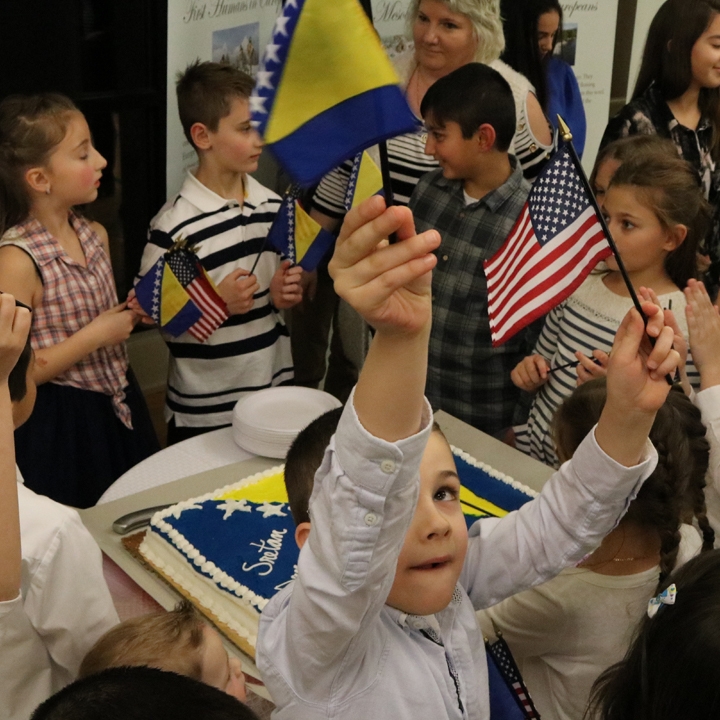
BiH Independence Day 2017
Following the conclusion of our 2017 Independence Day Event, we would like to share the results of the donations we received and thank the community for their support. Every dollar goes to supporting community initiatives. Hvala ljepo!
During our BiH Independence event, one of the challenges made by our team was for our community members to cover the expense of hall rental. This is a fair way for our community to demonstrate its willingness to support such programs, so that BAI doesn’t have to provide funds for community activity from its own institutional budget. While there are many other expenses associated with this event, this challenge was specifically about hall rental. Our accounting team has provided the following financial information:
Cost of Hall Compared to Donations Received
Therefore, we are glad to report that our community donations and drink sales covered the cost of hall rental. We also had a donation for one of the photos on display for $400.00. BAI absorbed the other costs of the event from its operational budget. As far as next year is concerned, if any local organizations express a desire, in the next several months, to lead the BiH Independence Day event, we will be glad to support them. Otherwise, you can count on the BAI team to come up with something for such an important occasion. Bosnia-Herzegovina’s independence is a precious milestone, and all members of our community should be enabled and empowered to celebrate it. Without our followers and community engagement, organizations like ours can only have limited impact. So thank you to those who have helped create a constituency and have found ways to support BAI, our young people, and other such institutions.